AutoClaw by Z.AI: The AI Assistant Inside Your Chats
AutoClaw by Z.AI turns chat into an execution surface with one-click OpenClaw setup, 50+ skills, browser automation, and cross-platform access globally.
Siri
Author
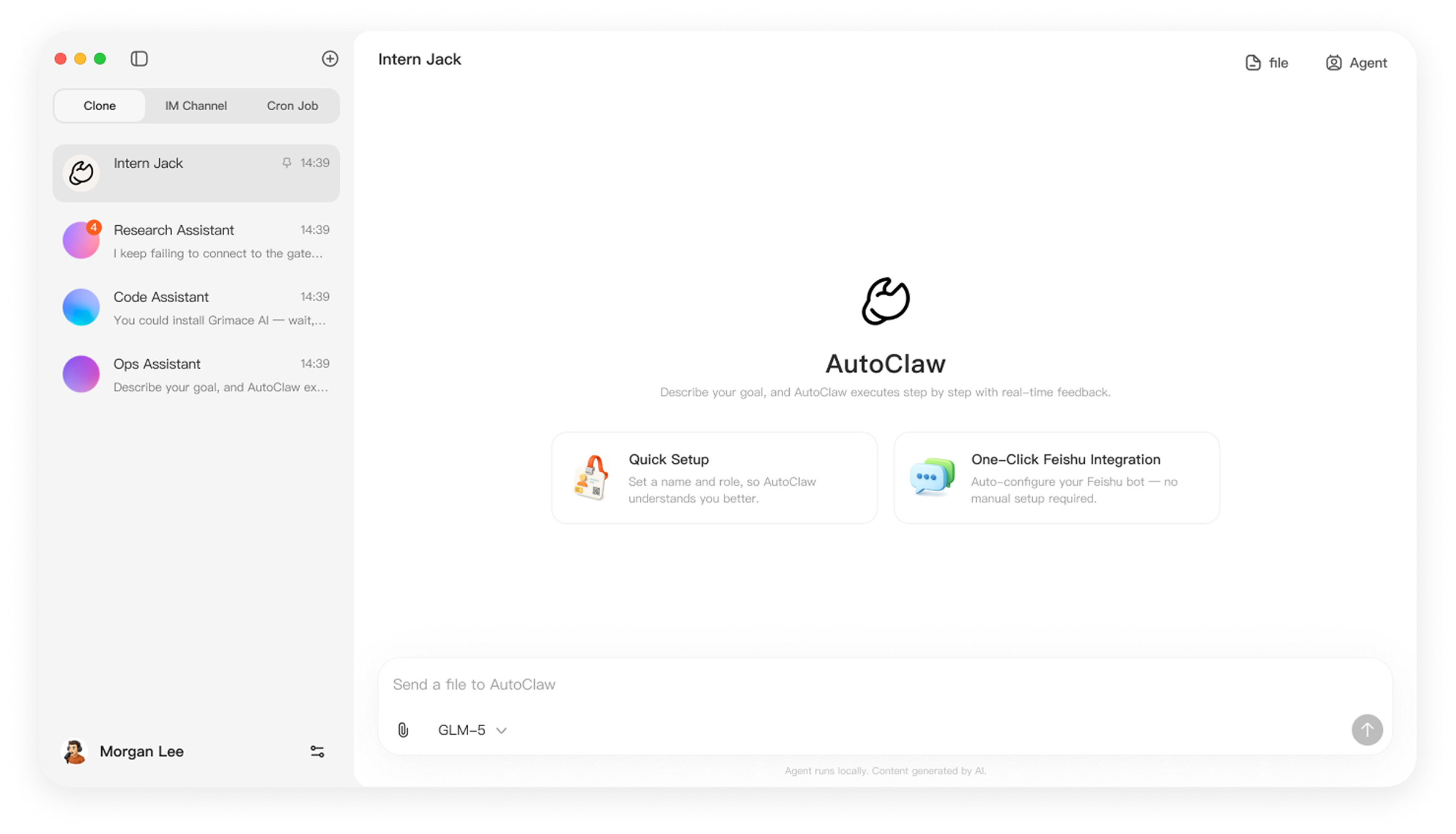
AutoClaw is not the same thing as AutoGLM's phone agent. On Z.AI's official landing page, AutoClaw is positioned as "your AI assistant, right inside your chats." That distinction matters. AutoClaw is a chat-native desktop product that wraps one-click OpenClaw setup, IM integration, skills, model switching, and browser automation into a simpler surface for real work.
Instead of pushing users into another dashboard, AutoClaw is built around a tighter loop: start with a message, let the assistant execute with real tools, and receive the result back in the same conversation. That is a much more practical product story than another chat window with better prompts.
What AutoClaw Actually Is
The official AutoClaw page describes the product as an AI assistant with one-click OpenClaw setup for Windows and macOS, IM integration, hot-swappable models, 50+ skills, and AutoGLM browser automation. The same page presents a simple three-step flow:
- Start with a message.
- Let the AI do the work with real tools.
- Get the result, context, and next steps back in chat.
That flow tells you what Z.AI is really selling. AutoClaw is not just an interface. It is an execution layer designed to make agent workflows feel native inside everyday conversations.
What Ships Today
From the current official landing page and download flow, AutoClaw currently offers:
- One-click OpenClaw setup
- Support for Windows 10 and Windows 11 on 64-bit systems
- Downloads for Apple Silicon Macs and Intel Macs
- IM integration so the assistant can work from the chat surface instead of a separate control panel
- Hot-swappable models
- 50+ skills
- AutoGLM browser automation
That combination is important. Plenty of AI products can answer a question. Far fewer make it easy to route execution through a familiar chat workflow while still exposing a modular stack underneath.
Pricing As Of April 2, 2026
As of April 2, 2026, Z.AI's official overseas AutoClaw product API listed four monthly plans:
| Plan | Price | Monthly Credits | Daily Credits |
|---|---|---|---|
| Lite | US$6/month | 5,000 | 0 |
| Base | US$20/month | 20,000 | 200 |
| Pro | US$100/month | 100,000 | 1,000 |
| Max | US$200/month | 200,000 | 2,000 |
The landing page does not explain task-level consumption in detail, so teams should treat those credits as a capacity signal rather than a clean estimate of completed workflows. Pricing and quotas can change, so the April 2, 2026 snapshot matters here.
Why AutoClaw Is Interesting
Chat Becomes The Control Plane
Most AI products still force users to think in terms of tools, panels, and setup screens. AutoClaw inverts that model. The chat becomes the place where goals are issued, work is tracked, and results return. That reduces operational friction, especially for teams already living in messaging tools all day.
It Lowers The OpenClaw Adoption Barrier
OpenClaw itself is powerful, but it is still an agent framework that usually expects installation, configuration, model selection, and channel setup. AutoClaw's value proposition is that it compresses that onboarding into a simpler, more productized experience.
That matters because many agent products fail before the first task ever runs. The setup cost is too high. AutoClaw is clearly designed to remove that failure point.
It Combines Execution With Modularity
Z.AI is not positioning AutoClaw as a sealed black box. The product page emphasizes hot-swappable models, 50+ skills, and OpenClaw setup. That suggests a hybrid model: easier entry for mainstream users, but enough openness to matter for developers and operators.
Browser Automation Changes The Ceiling
The AutoGLM browser automation angle is one of the most important lines on the page. Once an assistant can operate through the browser, the product stops being limited to chat completion and starts reaching into repetitive real-world workflows such as research, form filling, account checks, and task handoff.
That does not automatically make it reliable, but it makes the product category much more meaningful.
What AutoClaw Inherits From The Broader Z.AI Stack
AutoClaw makes more sense when you connect it to Z.AI's OpenClaw and GLM-5-Turbo documentation.
In Z.AI's developer docs, OpenClaw is described as a personal AI assistant that runs on your own devices and connects to multiple messaging platforms. Z.AI also says GLM-5-Turbo is deeply optimized for the OpenClaw scenario, especially for tool calling, instruction following, scheduled tasks, persistent execution, and long-chain workflows.
If you later move from the one-click AutoClaw experience to direct OpenClaw configuration, Z.AI's docs show the glm-5-turbo model entry in the OpenClaw config like this:
{
  "id": "glm-5-turbo",
  "name": "GLM-5-Turbo",
  "reasoning": true,
  "contextWindow": 204800,
  "maxTokens": 131072
}
That snippet matters because it shows AutoClaw is not floating alone as a marketing page. It sits on top of a broader agent stack that Z.AI is actively documenting and optimizing.
Where Teams Should Be Careful
AutoClaw looks promising, but there are still practical questions buyers should ask before rolling it into production work.
First, the landing page is strong on workflow framing and lighter on governance detail. It does not clearly spell out admin controls, auditability, approval gates, or enterprise security design on the public page.
Second, browser automation is powerful, but browser-driven agents inherit brittle surfaces. UI changes, authentication interruptions, and anti-bot protections can degrade reliability quickly.
Third, credits do not map cleanly to business outcomes. A cheap plan only matters if the assistant can complete the actual chain of work you need, with low enough failure rates to be worth the operating overhead.
Final Take
AutoClaw is one of the clearer signs that Z.AI is moving beyond model access and into packaged agent execution. The product is not just selling intelligence. It is selling a workflow: ask in chat, execute with tools, return the result where the conversation already lives.
That is the real appeal. AutoClaw lowers the setup barrier of OpenClaw, borrows strength from Z.AI's broader agent stack, and adds browser automation plus skill-based extensibility in a form normal users can actually start using.
If Z.AI can make the reliability match the positioning, AutoClaw could be much more than another AI assistant. It could become the easiest on-ramp into chat-native agent workflows.
Sources
Join the Verse
Get exclusive insights on Next.js, System Design, and Modern Web Development delivered straight to your inbox.
No spam. Unsubscribe at any time.